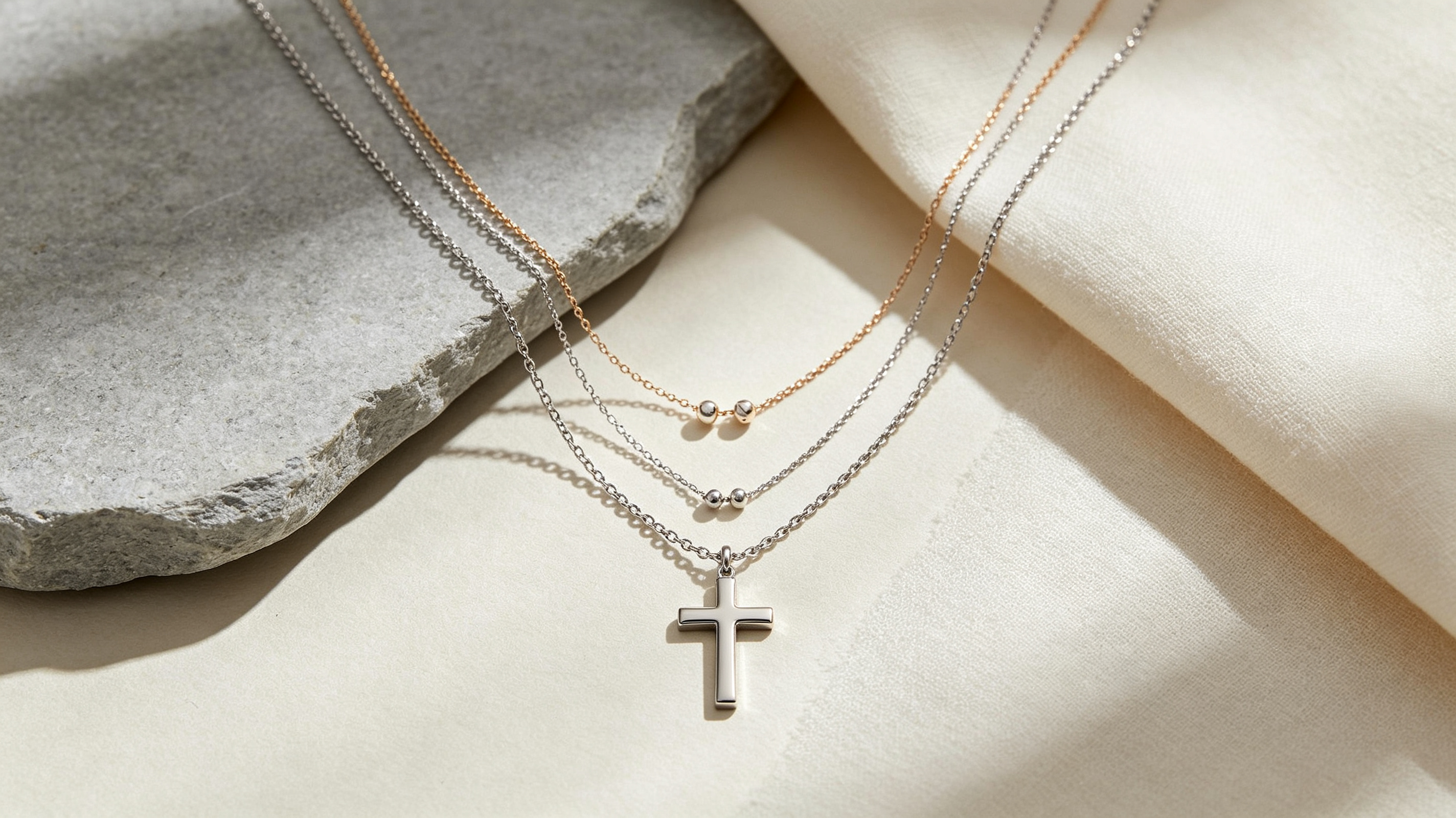
How to layer cross jewelry may carry faith, memory, identity, or affection, but the piece still has to survive real outfits, movement, storage, and care.
Common versions include cross necklace with plain chain, small cross with medallion, ring stacks, bracelet stacks, and mixed-metal layers. Each changes how visible the cross feels and how naturally it fits into a daily wardrobe.
This guide focuses on the decisions that are hardest to judge from a product photograph: length separation, pendant competition, and metal balance. It also covers styling, gifting, care, and quality checks.
How Symbolism Becomes Personal
The cross has a public religious identity, yet jewelry is worn in a personal space. For that reason, using different lengths, scales, and textures while keeping the cross as the visual anchor may overlap without being identical for every wearer.
Meaning also affects styling. Some people prefer a quiet piece close to the body, while others want a visible reminder that becomes part of their public identity.
Build the Layer Around One Main Cross
- Start with the neckline and decide where the cross should sit.
- Place the lightest chain highest and the heaviest piece lowest.
- Keep at least a small visual gap between pendants.
- Use no more than one additional symbolic pendant.
- Test the arrangement while moving, not only in a mirror.
Design Directions to Compare
Before comparing price, decide which design direction is realistic for the wearer:
- Cross Necklace With Plain Chain: Check scale, attachment points, and whether the design remains comfortable during movement.
- Small Cross With Medallion: Check scale, attachment points, and whether the design remains comfortable during movement.
- Ring Stacks: Check scale, attachment points, and whether the design remains comfortable during movement.
- Bracelet Stacks: Check scale, attachment points, and whether the design remains comfortable during movement.
- Mixed-Metal Layers: Check scale, attachment points, and whether the design remains comfortable during movement.
A balanced design still reads clearly without relying on excessive size, stones, or ornament.
Choosing a Material That Fits the Routine
Jewelry color is only the surface impression. Buyers should identify what lies beneath the finish and whether that construction fits the intended wear frequency.
- Silver-Tone Metal: Look for a specific composition instead of a vague color or “premium” label.
- Gold-Tone Metal: Look for a specific composition instead of a vague color or “premium” label.
- Stainless Steel: Look for a specific composition instead of a vague color or “premium” label.
- Fine Chains: Look for a specific composition instead of a vague color or “premium” label.
- Textured Chains: Look for a specific composition instead of a vague color or “premium” label.
If a seller does not identify the base material, assume you do not yet have enough information to compare value or care requirements.
Fit, Scale, and Physical Comfort
Words such as small, medium, and statement are inconsistent between sellers. Millimeters, inches, grams, and circumference are much more useful.
- Length Separation: Ask for a measurement or construction detail instead of relying on an adjective.
- Pendant Competition: Ask for a measurement or construction detail instead of relying on an adjective.
- Metal Balance: Ask for a measurement or construction detail instead of relying on an adjective.
- Chain Tangling: Ask for a measurement or construction detail instead of relying on an adjective.
- Outfit Neckline: Ask for a measurement or construction detail instead of relying on an adjective.
When exact preferences are unknown, moderate size and adjustable fit are safer than an unusually short, heavy, or rigid design.
Can It Handle Everyday Wear?
Daily wear is a practical test. The piece must remain comfortable around desks, bags, clothing, exercise, travel, and changing weather.
Even durable jewelry meets sweat, lotion, fragrance, fabric friction, and occasional impact. Regular wiping and sensible removal before swimming, showering, sleep, or strenuous activity can extend its useful life.
Make the Jewelry Part of the Wardrobe
Give the cross enough contrast to be visible, but avoid surrounding it with so many competing details that its shape disappears.
- Minimal Layering: Use simple surrounding details so the jewelry looks intentional rather than added at the last moment.
- Streetwear Layers: Use simple surrounding details so the jewelry looks intentional rather than added at the last moment.
- Soft Feminine Layers: Use simple surrounding details so the jewelry looks intentional rather than added at the last moment.
- Unisex Chains: Use simple surrounding details so the jewelry looks intentional rather than added at the last moment.
- Occasion Styling: Use simple surrounding details so the jewelry looks intentional rather than added at the last moment.
Mixed metals can work when both tones are repeated deliberately. Randomly adding a single conflicting finish is more likely to look accidental.
How to Choose It as a Meaningful Present
A symbolic gift should begin with the recipient rather than the occasion. Notice what they wear repeatedly, what metals they avoid, and whether they prefer private or visible expressions of faith.
Adjustable fit, clear care guidance, secure packaging, and a reasonable return window are practical parts of a thoughtful present.
Use the cross necklace collection to compare measurements, materials, and the overall design direction before choosing.
A Simple Care Routine
- Apply fragrance, lotion, sunscreen, and hair products before putting on the jewelry.
- Wipe the piece with a soft dry cloth after heavy wear.
- Use only a cleaner that is safe for the exact material and finish.
- Dry links, clasps, settings, and cords fully before storage.
- Store pieces separately to limit scratches and tangles.
When material information is incomplete, begin with a dry cloth and avoid ultrasonic machines, abrasive pastes, and long soaking.
Small Mistakes That Shorten the Life of the Piece
- Skipping measurements: The word “medium” does not guarantee a familiar size.
- Choosing for the occasion only: A gift still needs to work after the celebration ends.
- Assuming all crosses mean the same thing: Form and tradition can change context.
- Leaving pieces wet: Moisture and residue can collect around links, settings, and cords.
- Storing everything together: Chains, stones, and hard metal edges can scratch one another.
FAQ
Is how to layer cross jewelry a meaningful gift?
Yes. It can express using different lengths, scales, and textures while keeping the cross as the visual anchor. Choose according to the recipient’s own beliefs, style, size, and willingness to care for the material.
Can different metal tones be layered with how to layer cross jewelry?
Yes. Repeat both tones elsewhere in the outfit and keep the number of pendants controlled so the mix looks intentional.
How can I recognize good-quality how to layer cross jewelry?
Look for named materials, consistent measurements, smooth finishing, reliable closures, secure stones or cords, realistic durability claims, and accessible customer support.
How many pieces should be layered with how to layer cross jewelry?
Usually one or two additional chains are enough. Keep one cross as the main symbol and separate the lengths clearly.
Can how to layer cross jewelry be worn every day?
How to layer cross jewelry can suit daily wear when the piece is comfortable, secure, and made for the wearer’s routine. Delicate finishes still need reasonable removal and care.
Make the Symbol Work in Everyday Life
A successful how to layer cross jewelry purchase feels specific to the wearer. Material, proportion, finish, and routine should support the meaning rather than compete with it.
Use length separation, pendant competition, metal balance, chain tangling, and outfit neckline as a final checklist. Those details make it easier to choose a piece that remains personal and useful after the first impression.