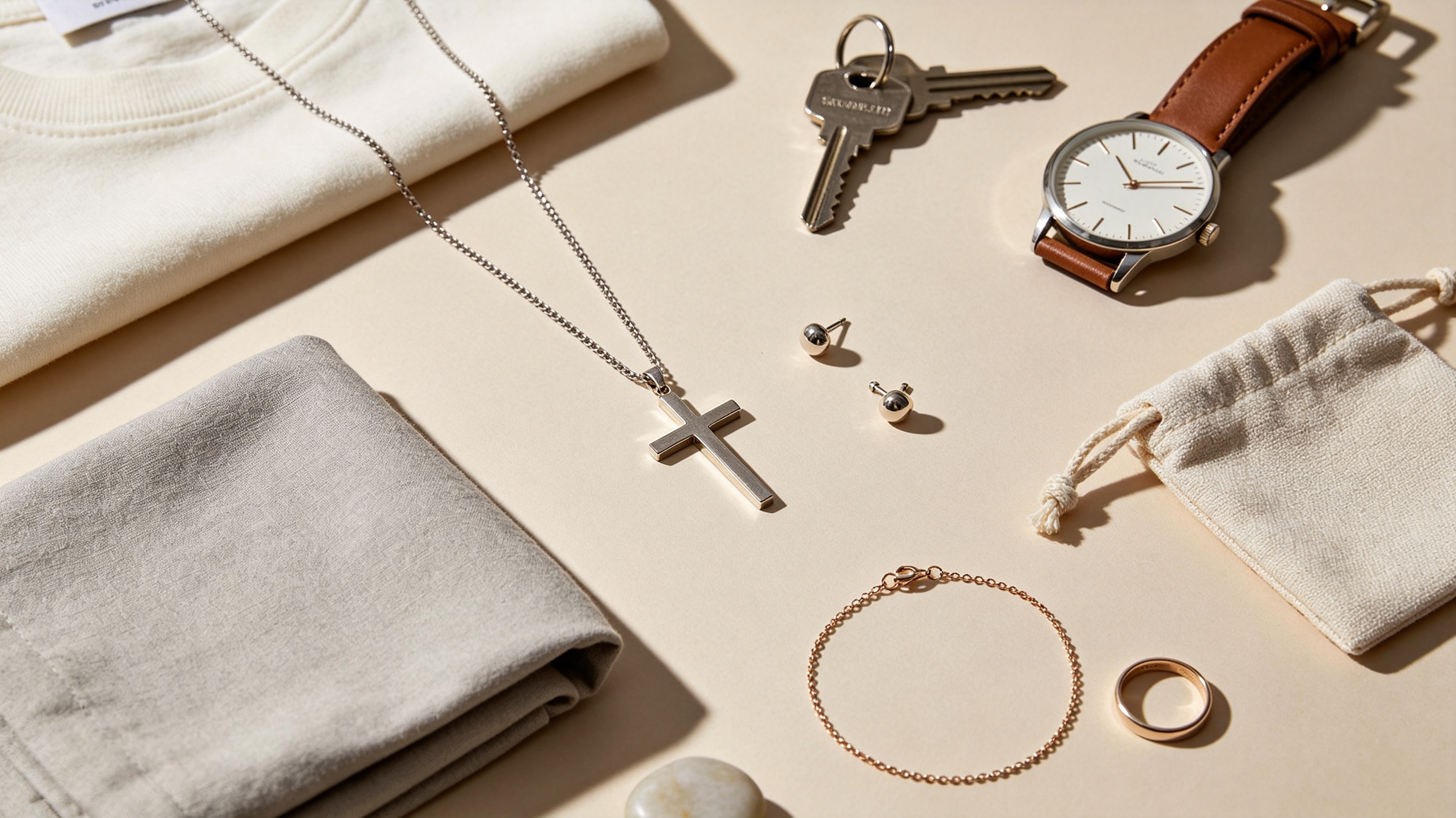
Cross jewelry for everyday wear is not one fixed look. It can be quiet and private, visible and expressive, traditional, modern, or somewhere between those directions.
The design range extends from smooth pendants to simple sets. That range allows personal choice, but it also creates very different care and comfort requirements.
Rather than treating the cross as a trend label, this guide examines weight, snagging, water exposure, clasp security, and maintenance so the final choice feels intentional in ordinary life.
Understanding Cross jewelry for everyday wear
Cross jewelry for everyday wear describes pieces in which the cross is the main pendant, shape, engraving, or structural detail. It may appear as smooth pendants, low-profile rings, secure bracelets, small earrings, and simple sets.
A useful listing should identify the base material, finish, dimensions, closure, weight, and care limits. Color alone does not reveal how the piece is constructed.
How Symbolism Becomes Personal
People may choose this piece for a reliable daily reminder that fits work, travel, worship, and casual life. A gift, family history, milestone, or difficult season can add meaning that is not visible from the design alone.
A symbol does not need to be large to be meaningful. Private wear under clothing can be as intentional as a pendant displayed as part of an outfit.
How to Shortlist the Right Piece
Compare weight, snagging, water exposure, clasp security, and maintenance before deciding. These details predict satisfaction more reliably than trend language.
The final choice should work with the wearer’s ordinary clothes, movement, and care habits. Meaning is easier to preserve when the piece is comfortable enough to use.
Choosing the Form of the Piece
The strongest choice is not always the most detailed. Consider how each form behaves on the body:
- Smooth Pendants: Consider whether it is meant to be a quiet detail, a visible focal point, or part of a coordinated set.
- Low-Profile Rings: Consider whether it is meant to be a quiet detail, a visible focal point, or part of a coordinated set.
- Secure Bracelets: Consider whether it is meant to be a quiet detail, a visible focal point, or part of a coordinated set.
- Small Earrings: Consider whether it is meant to be a quiet detail, a visible focal point, or part of a coordinated set.
- Simple Sets: Consider whether it is meant to be a quiet detail, a visible focal point, or part of a coordinated set.
A balanced design still reads clearly without relying on excessive size, stones, or ornament.
Comfort Checks That Product Photos Cannot Show
Proportion should be judged against the wearer’s body and wardrobe, not against an enlarged product image.
- Weight: Compare this with a piece the wearer already finds comfortable.
- Snagging: Compare this with a piece the wearer already finds comfortable.
- Water Exposure: Compare this with a piece the wearer already finds comfortable.
- Clasp Security: Compare this with a piece the wearer already finds comfortable.
- Maintenance: Compare this with a piece the wearer already finds comfortable.
When exact preferences are unknown, moderate size and adjustable fit are safer than an unusually short, heavy, or rigid design.
How Material Changes the Experience
Jewelry color is only the surface impression. Buyers should identify what lies beneath the finish and whether that construction fits the intended wear frequency.
- Stainless Steel: Look for a specific composition instead of a vague color or “premium” label.
- Solid Gold: Look for a specific composition instead of a vague color or “premium” label.
- Titanium: Look for a specific composition instead of a vague color or “premium” label.
- Sterling Silver: Look for a specific composition instead of a vague color or “premium” label.
- Carefully Finished Wood: Look for a specific composition instead of a vague color or “premium” label.
Terms such as gold-tone, silver-tone, and luxury alloy describe appearance more than composition. Exact wording creates better expectations.
When the Piece Becomes Part of a Routine
A design becomes an everyday piece when the wearer can put it on easily, forget about unnecessary discomfort, and care for it without a complicated routine.
The right routine depends on construction. A plain steel pendant, a plated ring, a wooden cross, and a stone-set earring should not be treated as though they have the same tolerance.
Outfit Ideas That Give the Cross Space
The simplest styling rule is to decide whether the piece is the focal point or a quiet supporting detail.
- Workwear: Use simple surrounding details so the jewelry looks intentional rather than added at the last moment.
- Travel Outfits: Use simple surrounding details so the jewelry looks intentional rather than added at the last moment.
- Gym-To-Street Basics: Use simple surrounding details so the jewelry looks intentional rather than added at the last moment.
- Weekend Clothing: Use simple surrounding details so the jewelry looks intentional rather than added at the last moment.
- Daily Faith Expression: Use simple surrounding details so the jewelry looks intentional rather than added at the last moment.
The wearer should still recognize themselves in the outfit. Styling should support meaning rather than turn the piece into a costume.
Is It a Good Gift?
The cross already carries emotional weight, so the design does not need to be oversized to feel special. Comfort and familiarity often make a gift more meaningful over time.
Adjustable fit, clear care guidance, secure packaging, and a reasonable return window are practical parts of a thoughtful present.
Use the CrossMira jewelry care guide to compare measurements, materials, and the overall design direction before choosing.
A Simple Care Routine
- Take the piece off before swimming, showering, strenuous exercise, or household cleaning.
- Blot moisture rather than rubbing delicate finishes aggressively.
- Keep silver polishing products away from stones, plating, and intentionally dark details unless approved.
- Separate chains so they cannot knot around rings or earrings.
- Seek repair when a stone moves or a closure no longer feels reliable.
Good care is usually brief and consistent. Repeated gentle maintenance is safer than occasional aggressive cleaning.
Quality Checks Before You Pay
- Specific material: The base metal, plating, stone, wood, or textile is named.
- Useful measurements: Dimensions, weight, length, circumference, or ring size are provided.
- Clean finishing: Edges, bails, posts, solder points, and clasps appear smooth and aligned.
- Secure assembly: Jump rings, stones, cords, hinges, and closures do not rely on weak connections.
- Care limits: The seller explains moisture, chemical, storage, and cleaning requirements.
Original photographs and clear return terms make comparison easier because they reveal scale and show whether the seller stands behind the description.
Small Mistakes That Shorten the Life of the Piece
- Skipping measurements: The word “medium” does not guarantee a familiar size.
- Choosing for the occasion only: A gift still needs to work after the celebration ends.
- Assuming all crosses mean the same thing: Form and tradition can change context.
- Leaving pieces wet: Moisture and residue can collect around links, settings, and cords.
- Storing everything together: Chains, stones, and hard metal edges can scratch one another.
Frequently Asked Questions
How should cross jewelry for everyday wear be stored?
Keep it dry and separate from harder pieces. Untangle chains, use padded ring slots, secure earring pairs, and protect wood, plating, and stones from friction.
How can I recognize good-quality cross jewelry for everyday wear?
Look for named materials, consistent measurements, smooth finishing, reliable closures, secure stones or cords, realistic durability claims, and accessible customer support.
What should I check before buying cross jewelry for everyday wear?
Check weight, snagging, and water exposure, exact material disclosure, measurements, construction photographs, care guidance, and return terms.
Can cross jewelry for everyday wear be worn every day?
Cross jewelry for everyday wear can suit daily wear when the piece is comfortable, secure, and made for the wearer’s routine. Delicate finishes still need reasonable removal and care.
Is cross jewelry for everyday wear a meaningful gift?
Yes. It can express a reliable daily reminder that fits work, travel, worship, and casual life. Choose according to the recipient’s own beliefs, style, size, and willingness to care for the material.
Choosing Cross jewelry for everyday wear With Confidence
When cross jewelry for everyday wear is chosen carefully, the jewelry can move beyond a one-day purchase and become part of a daily or milestone routine.
The symbol already carries emotional weight. Good design lets that meaning remain visible without making the piece uncomfortable or difficult to maintain.