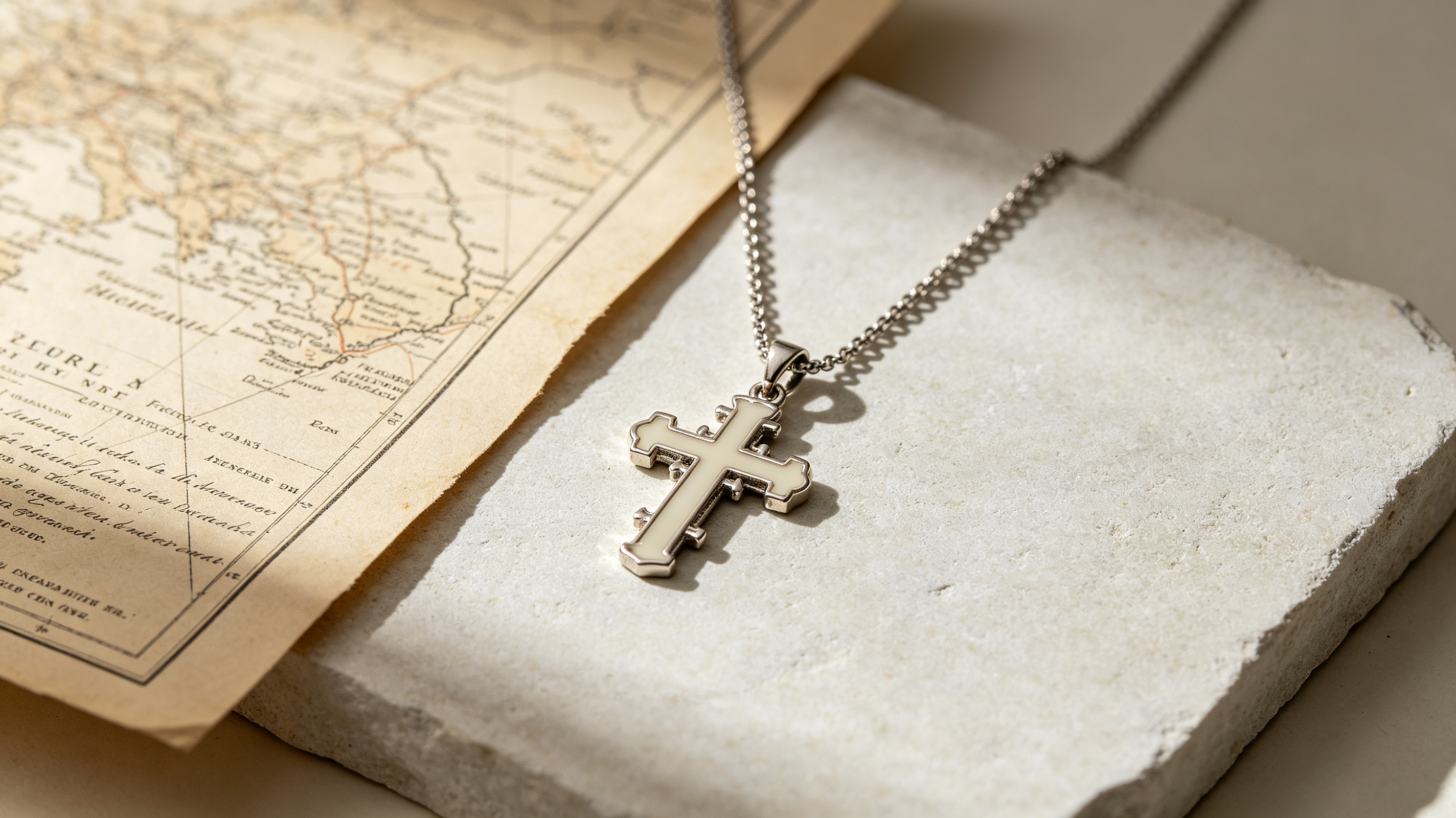
Jerusalem cross necklace meaning may carry faith, memory, identity, or affection, but the piece still has to survive real outfits, movement, storage, and care.
Common versions include five-cross pendants, olive-wood inlays, engraved silver pieces, enamel crosses, and pilgrimage medallions. Each changes how visible the cross feels and how naturally it fits into a daily wardrobe.
The most useful buying questions are whether multiple interpretations is appropriate, whether historical context is clearly explained, and whether the piece suits private devotional wear as well as special occasions.
Defining the Style Before You Buy
The term Jerusalem cross necklace meaning can cover more than a single product type. It includes designs such as five-cross pendants, olive-wood inlays, engraved silver pieces, enamel crosses, and pilgrimage medallions and may range from private devotional pieces to visible fashion jewelry.
A useful listing should identify the base material, finish, dimensions, closure, weight, and care limits. Color alone does not reveal how the piece is constructed.
Tradition Behind the Design
The form consists of one large cross and four smaller crosses. Common interpretations include Christ and the four Evangelists, the five wounds of Christ, or the Gospel reaching the four corners of the world. These interpretations are devotional traditions rather than a single exclusive definition.
Jewelry makers often simplify historic forms so they sit comfortably on the body. That adaptation is reasonable, but the product description should distinguish documented history from later devotional interpretation.
What the Piece Can Mean
This jewelry may express a layered Christian symbol often connected with Jerusalem, pilgrimage, evangelism, and the wider world. The shared symbol provides a starting point, while the wearer’s experience gives it a more private significance.
A symbol does not need to be large to be meaningful. Private wear under clothing can be as intentional as a pendant displayed as part of an outfit.
Questions to Ask About the Symbol
Identify the exact cross form before buying. Check whether the design belongs to a church tradition, a historical order, a regional heritage, or a modern fashion treatment.
For gifts, confirm that the wearer is comfortable with the specific symbol and not only with cross jewelry in general.
Common Styles and What They Change
Different designs change visibility, movement, and the amount of maintenance required. Compare the options according to the wearer’s routine:
- Five-Cross Pendants: This option changes how the cross is seen at normal distance and how easily it can be worn with ordinary clothing.
- Olive-Wood Inlays: This option changes how the cross is seen at normal distance and how easily it can be worn with ordinary clothing.
- Engraved Silver Pieces: This option changes how the cross is seen at normal distance and how easily it can be worn with ordinary clothing.
- Enamel Crosses: This option changes how the cross is seen at normal distance and how easily it can be worn with ordinary clothing.
- Pilgrimage Medallions: This option changes how the cross is seen at normal distance and how easily it can be worn with ordinary clothing.
If the wearer is new to jewelry, a moderate version is usually easier to adopt than an extreme statement piece.
Materials, Finishes, and What They Mean for Wear
Material affects weight, color stability, skin contact, price, and the safest cleaning method. Similar photographs do not guarantee similar performance.
- Sterling Silver: Compare expected weight, surface wear, and skin compatibility before choosing.
- Gold: Compare expected weight, surface wear, and skin compatibility before choosing.
- Stainless Steel: Compare expected weight, surface wear, and skin compatibility before choosing.
- Olive Wood: Compare expected weight, surface wear, and skin compatibility before choosing.
- Enamel: Compare expected weight, surface wear, and skin compatibility before choosing.
Solid, plated, filled, vermeil, stainless steel, sterling silver, and natural wood are not interchangeable descriptions. Each should be stated plainly.
How to Judge Proportion Before Ordering
Fit includes more than chain length or ring size. Weight, edge shape, clasp placement, movement, and contact with clothing all affect whether a piece is worn often.
- Multiple Interpretations: Consider how this behaves after several hours, not only when first tried on.
- Historical Context: Consider how this behaves after several hours, not only when first tried on.
- Origin Claims: Consider how this behaves after several hours, not only when first tried on.
- Recipient Faith: Consider how this behaves after several hours, not only when first tried on.
- Design Accuracy: Consider how this behaves after several hours, not only when first tried on.
When exact preferences are unknown, moderate size and adjustable fit are safer than an unusually short, heavy, or rigid design.
How to Wear the Piece Naturally
The simplest styling rule is to decide whether the piece is the focal point or a quiet supporting detail.
- Private Devotional Wear: Match chain, scale, or finish to the texture and formality of the clothing.
- Travel Keepsakes: Match chain, scale, or finish to the texture and formality of the clothing.
- Faith Gifts: Match chain, scale, or finish to the texture and formality of the clothing.
- Heritage Jewelry: Match chain, scale, or finish to the texture and formality of the clothing.
- Simple Daily Outfits: Match chain, scale, or finish to the texture and formality of the clothing.
If the jewelry is bold, reduce other pendants and patterns. If it is delicate, use neckline and layering to keep it visible.
How to Choose It as a Meaningful Present
A symbolic gift should begin with the recipient rather than the occasion. Notice what they wear repeatedly, what metals they avoid, and whether they prefer private or visible expressions of faith.
Adjustable fit, clear care guidance, secure packaging, and a reasonable return window are practical parts of a thoughtful present.
Use the CrossMira blog to compare measurements, materials, and the overall design direction before choosing.
A Simple Care Routine
- Take the piece off before swimming, showering, strenuous exercise, or household cleaning.
- Blot moisture rather than rubbing delicate finishes aggressively.
- Keep silver polishing products away from stones, plating, and intentionally dark details unless approved.
- Separate chains so they cannot knot around rings or earrings.
- Seek repair when a stone moves or a closure no longer feels reliable.
Good care is usually brief and consistent. Repeated gentle maintenance is safer than occasional aggressive cleaning.
Small Mistakes That Shorten the Life of the Piece
- Buying from an enlarged image: Close-ups can hide true scale and weight.
- Confusing color with composition: Gold-tone and silver-tone do not identify the base material.
- Ignoring routine: Delicate construction may not fit sports, travel, manual work, or water exposure.
- Overstyling the symbol: Too many competing pendants can make the cross visually disappear.
- Using the wrong cleaner: One harsh method can remove plating, flatten oxidation, loosen stones, or damage wood.
FAQ
How can I recognize good-quality Jerusalem cross necklace meaning?
Look for named materials, consistent measurements, smooth finishing, reliable closures, secure stones or cords, realistic durability claims, and accessible customer support.
Does Jerusalem cross necklace meaning have one fixed meaning?
Not always. Historic forms have documented contexts, while devotional and personal interpretations can vary across communities. Use careful sources and respect the wearer’s tradition.
Can Jerusalem cross necklace meaning be worn every day?
Jerusalem cross necklace meaning can suit daily wear when the piece is comfortable, secure, and made for the wearer’s routine. Delicate finishes still need reasonable removal and care.
Is Jerusalem cross necklace meaning a meaningful gift?
Yes. It can express a layered Christian symbol often connected with Jerusalem, pilgrimage, evangelism, and the wider world. Choose according to the recipient’s own beliefs, style, size, and willingness to care for the material.
Can Jerusalem cross necklace meaning be worn by someone outside the tradition?
That depends on context and intention. Learn what the symbol represents, avoid using organization-specific emblems casually, and prioritize respect over novelty.
A Better Way to Choose a Lasting Piece
The best Jerusalem cross necklace meaning is not automatically the most expensive, largest, or most decorative option. It is the piece that balances symbolism with construction and comfort.
Use multiple interpretations, historical context, origin claims, recipient faith, and design accuracy as a final checklist. Those details make it easier to choose a piece that remains personal and useful after the first impression.