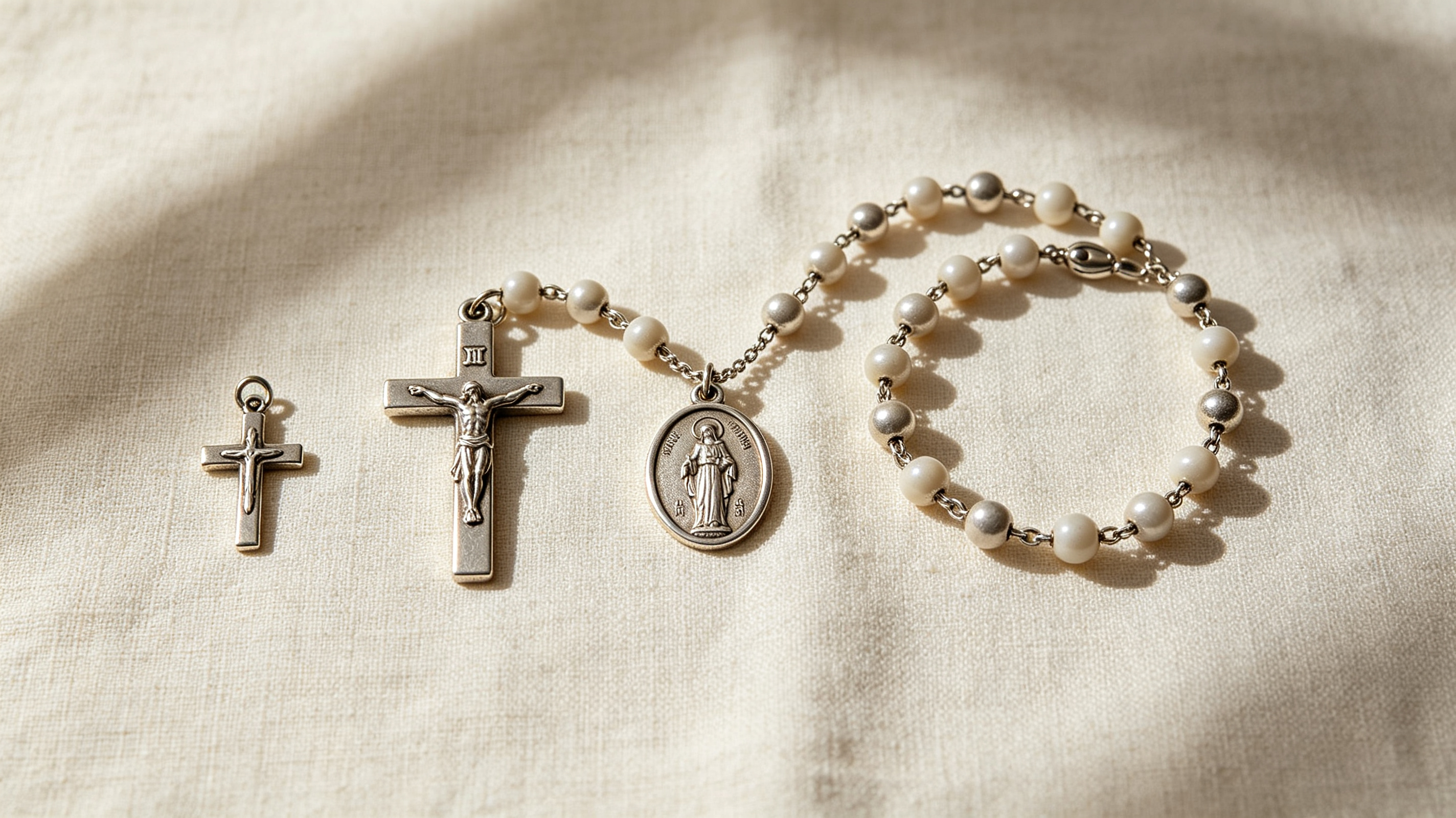
Catholic religious jewelry becomes more useful when the buyer looks beyond the symbol and studies how the piece is actually made and worn.
Common versions include crucifixes, cross pendants, saint medals, rosary bracelets, and Marian medallions. Each changes how visible the cross feels and how naturally it fits into a daily wardrobe.
The most useful buying questions are whether cross versus crucifix is appropriate, whether sacramental context is clearly explained, and whether the piece suits daily devotional wear as well as special occasions.
Understanding Catholic religious jewelry
The term Catholic religious jewelry can cover more than a single product type. It includes designs such as crucifixes, cross pendants, saint medals, rosary bracelets, and Marian medallions and may range from private devotional pieces to visible fashion jewelry.
The category includes both fashion jewelry and long-term keepsakes. The difference is usually found in material disclosure, finishing, repairability, and the precision of small components.
History Without Oversimplification
Catholic jewelry may include both plain crosses and crucifixes showing the figure of Christ, as well as medals and rosary-inspired pieces. The meaning of a specific item depends on its devotional use and the wearer’s tradition.
A responsible buying guide avoids presenting one interpretation as the only possible meaning. It gives the wearer enough context to choose the symbol knowingly.
How Symbolism Becomes Personal
This jewelry may express faith, devotion, sacramental memory, prayer, and connection with Catholic tradition. The shared symbol provides a starting point, while the wearer’s experience gives it a more private significance.
When buying for another person, ask what the symbol means to them instead of assigning a message on their behalf. Respect is more important than choosing the most elaborate design.
Accuracy Matters More Than Novelty
A respectful purchase begins with correct naming. Similar-looking crosses can carry different histories, and some emblems are closely linked with particular communities or organizations.
A contemporary adaptation can still be meaningful when it is described honestly. The problem is not modern design; it is misleading historical or spiritual claims.
The Main Design Choices
Before comparing price, decide which design direction is realistic for the wearer:
- Crucifixes: This option changes how the cross is seen at normal distance and how easily it can be worn with ordinary clothing.
- Cross Pendants: This option changes how the cross is seen at normal distance and how easily it can be worn with ordinary clothing.
- Saint Medals: This option changes how the cross is seen at normal distance and how easily it can be worn with ordinary clothing.
- Rosary Bracelets: This option changes how the cross is seen at normal distance and how easily it can be worn with ordinary clothing.
- Marian Medallions: This option changes how the cross is seen at normal distance and how easily it can be worn with ordinary clothing.
If the wearer is new to jewelry, a moderate version is usually easier to adopt than an extreme statement piece.
How to Judge Proportion Before Ordering
A piece can be visually beautiful and still fail because it twists, catches, pinches, or sits at the wrong height. Check the physical details before choosing.
- Cross Versus Crucifix: Compare this with a piece the wearer already finds comfortable.
- Sacramental Context: Compare this with a piece the wearer already finds comfortable.
- Recipient Devotion: Compare this with a piece the wearer already finds comfortable.
- Blessing Traditions: Compare this with a piece the wearer already finds comfortable.
- Accurate Symbolism: Compare this with a piece the wearer already finds comfortable.
A few minutes spent comparing measurements can prevent most returns caused by scale and comfort.
Read the Material Description Carefully
The base material matters more than the marketing name. It determines how the piece responds to sweat, water, friction, and polishing.
- Silver: Ask how it should be cleaned and what kinds of moisture or chemicals should be avoided.
- Gold: Ask how it should be cleaned and what kinds of moisture or chemicals should be avoided.
- Stainless Steel: Ask how it should be cleaned and what kinds of moisture or chemicals should be avoided.
- Wood: Ask how it should be cleaned and what kinds of moisture or chemicals should be avoided.
- Enamel And Stone Accents: Ask how it should be cleaned and what kinds of moisture or chemicals should be avoided.
Solid, plated, filled, vermeil, stainless steel, sterling silver, and natural wood are not interchangeable descriptions. Each should be stated plainly.
Outfit Ideas That Give the Cross Space
Give the cross enough contrast to be visible, but avoid surrounding it with so many competing details that its shape disappears.
- Daily Devotional Wear: Match chain, scale, or finish to the texture and formality of the clothing.
- Baptism Gifts: Match chain, scale, or finish to the texture and formality of the clothing.
- First Communion Gifts: Match chain, scale, or finish to the texture and formality of the clothing.
- Confirmation Gifts: Match chain, scale, or finish to the texture and formality of the clothing.
- Family Keepsakes: Match chain, scale, or finish to the texture and formality of the clothing.
The wearer should still recognize themselves in the outfit. Styling should support meaning rather than turn the piece into a costume.
How to Choose It as a Meaningful Present
A symbolic gift should begin with the recipient rather than the occasion. Notice what they wear repeatedly, what metals they avoid, and whether they prefer private or visible expressions of faith.
If exact style is uncertain, a moderate design is safer than an extreme statement piece. Personal meaning can come from the message and occasion rather than scale alone.
Use the meaningful jewelry collection to compare measurements, materials, and the overall design direction before choosing.
A Simple Care Routine
- Inspect the clasp, posts, stones, and attachment points before cleaning.
- Remove ordinary skin oils with a clean microfiber cloth.
- Use mild soap only when the material description allows it.
- Avoid soaking mixed-material, plated, glued, wooden, or oxidized pieces.
- Return each item to a dry compartment or pouch after wear.
When material information is incomplete, begin with a dry cloth and avoid ultrasonic machines, abrasive pastes, and long soaking.
What to Avoid
- Skipping measurements: The word “medium” does not guarantee a familiar size.
- Choosing for the occasion only: A gift still needs to work after the celebration ends.
- Assuming all crosses mean the same thing: Form and tradition can change context.
- Leaving pieces wet: Moisture and residue can collect around links, settings, and cords.
- Storing everything together: Chains, stones, and hard metal edges can scratch one another.
Frequently Asked Questions
Can Catholic religious jewelry be worn by someone outside the tradition?
That depends on context and intention. Learn what the symbol represents, avoid using organization-specific emblems casually, and prioritize respect over novelty.
How can I recognize good-quality Catholic religious jewelry?
Look for named materials, consistent measurements, smooth finishing, reliable closures, secure stones or cords, realistic durability claims, and accessible customer support.
Does Catholic religious jewelry have one fixed meaning?
Not always. Historic forms have documented contexts, while devotional and personal interpretations can vary across communities. Use careful sources and respect the wearer’s tradition.
Can Catholic religious jewelry be worn every day?
Catholic religious jewelry can suit daily wear when the piece is comfortable, secure, and made for the wearer’s routine. Delicate finishes still need reasonable removal and care.
Is Catholic religious jewelry a meaningful gift?
Yes. It can express faith, devotion, sacramental memory, prayer, and connection with Catholic tradition. Choose according to the recipient’s own beliefs, style, size, and willingness to care for the material.
A Better Way to Choose a Lasting Piece
The best Catholic religious jewelry is not automatically the most expensive, largest, or most decorative option. It is the piece that balances symbolism with construction and comfort.
Choose slowly enough to verify the facts, but do not confuse complexity with quality. Clear materials, balanced proportions, and realistic care are often the strongest signs.