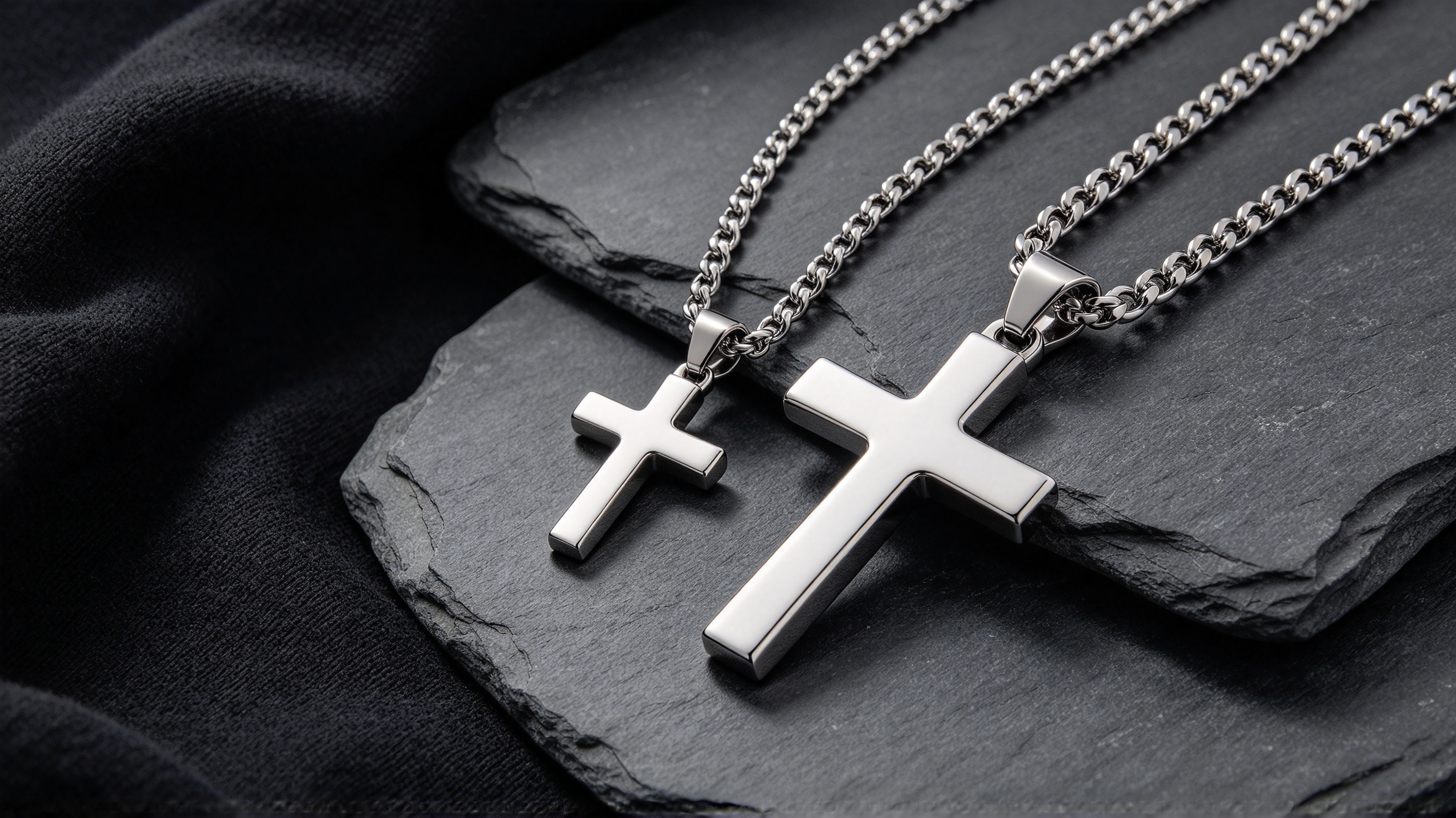
The hardest part when choosing a small or large cross necklace is separating what can be verified from what is simply taste. Dimensions, hardware and materials can be checked; whether the result feels subtle, bold or personal depends on the wearer.
The point is not to eliminate preference. It is to make sure preference is not being asked to compensate for unclear materials, poor fit or weak construction.
Choosing a Small or Large Cross Necklace by Proportion
When choosing a small or large cross necklace, start with measurable details rather than adjectives. Pendant height and width, chain length, chain width, total weight and closure type are more useful than labels such as delicate, premium or bold.
Product photography should help you judge scale, but a photograph can exaggerate a small pendant or hide a thick chain. Look for dimensions and on-body references whenever possible.
The Better Option Depends on How Often It Will Be Worn
If the necklace will be worn several times a week, comfort, clasp security and easy cleaning usually matter more than a small difference in initial appearance. For occasional wear, a more specialized finish or heavier design may be easier to justify.
Appearance Is Only Half the Comparison
The visually richer option may require more care. A coating can deliver a specific color; a precious-metal alloy can offer intrinsic material value; a darker finish can hide some wear while showing edge abrasion more clearly.
Read the full material description for both pendant and chain because mixed-material jewelry can behave differently at each component.
For the surrounding fit and care questions, see CrossMira cross necklace collection, Cross Necklace Chain Length Guide and How to Style a Cross Necklace.
Different Use Cases Favor Different Choices
Choose the more restrained option for work, layering or a first cross necklace. Choose the more expressive option when the wearer already uses visible jewelry and the pendant is meant to be a focal point.
A Practical Tie-Breaker
If two options look equally good, choose the one whose material, dimensions and care requirements are described more clearly. Better information reduces the risk of buying the wrong piece.
Run a Real-World Wear Check
Before making a final decision when choosing a small or large cross necklace, reproduce the conditions in which the jewelry will be worn. Use a chain or cord at the intended length, stand in normal daylight, put on the shirt or outer layer you expect to use, and check the pendant from normal conversational distance. A cross that looks perfectly proportioned in a close-up image can feel very different once body frame and clothing enter the picture.
Then separate structural questions from taste. Structural questions have verifiable answers: Does the clasp close? Does the bail clear the chain end? Are the jump rings closed? Are materials disclosed? Are the dimensions clear? Taste questions are personal: Is the cross too bold, too quiet, too polished or too dark? Making that distinction keeps subjective style from hiding objective quality problems.
A Better Way to Compare Near-Identical Options
When two products both seem to fit the same decision, compare them line by line instead of relying on the hero image. Put pendant height, pendant width, chain length, chain width, material, finish, clasp type, weight if available, care requirements and return terms in the same order. The better product is not automatically the one with the longest specification list; it is the one whose specifications answer the questions that matter for your use case.
Pay special attention to omissions. If one listing gives a pendant size but no chain width, or names a gold color without explaining whether it is solid gold, plating or another coating, that missing information creates uncertainty. A strong seller should make the basic construction easy to understand before asking you to buy.
Use Product Photos for Shape, Not Exact Scale
Product photography is best used to judge shape, surface character and styling possibilities. It is less reliable for exact size unless there is a scale reference, because camera distance, focal length and cropping can make a pendant look larger or smaller than it is. On-body images are most useful when the model’s chain length and pendant dimensions are disclosed.
Zoom in on connection points, edge quality and symmetry, then zoom back out. A piece of jewelry must work at both distances: close enough to reward inspection and far enough away to read as a balanced part of the outfit. That two-distance check is especially useful for crosses because their geometry is easy to recognize.
What a Complete Product Page Should Tell You
When choosing a small or large cross necklace, ask for any missing specification that would change fit or durability. Useful answers include exact pendant dimensions, chain length and width, base metal, coating or plating method, clasp type, whether the pendant can be removed from the chain, and the recommended care routine. If a product uses stones, pearls, wood or a colored surface, the listing should identify what those components actually are rather than relying on a color name or a broad style label.
Return terms are also part of product quality from the buyer’s point of view. Jewelry can be correctly made and still be the wrong scale on a particular body. A clear return window, realistic photography and complete dimensions reduce the pressure to guess and make it easier to choose on fit rather than on marketing language.
The Right Piece Should Work Beyond the Product Photo
The strongest choice is the one that survives a practical check: the scale works on the wearer, the chain and pendant are compatible, the hardware is secure, the material matches the expected care routine, and the design carries the meaning or style the wearer actually wants.
For “Small or Large Cross Necklace — Which Size Fits Your Style?,” there is no need to force a universal rule. Use measurements for fit, construction for quality and the wearer’s real wardrobe for style. When those three agree, the necklace has a much better chance of being worn rather than stored.